The Systemic Exfiltration
In late 2025, a Tier-1 asset management firm inadvertently compromised quarterly projection models. The exfiltration vector was not a sophisticated breach, but a catastrophic $10M copy-paste error: a junior analyst submitted proprietary CSV data into a public AI instance to “format a deck.”
The $10M figure reflects the combined cost of the trading model’s competitive value, the client-notification obligations the disclosure triggered, and the engagement required to determine exactly what had been exposed. None of that cost traced to a flaw in the firm’s trading model itself; it traced entirely to a formatting task routed through the wrong tool.
For law and finance entities, this represents a severe data exfiltration event driving the industry-wide ban on public AI.
The incident is representative, not exceptional. The failure mode is rarely a sophisticated attack; it is an employee using a familiar consumer tool for a mundane task, with no awareness that the organization’s data boundary has just been crossed. No malware was involved, no credentials were stolen, and from the perspective of conventional security tooling, nothing anomalous occurred at all — the traffic was a normal HTTPS request to a popular, widely whitelisted consumer domain.
The Leak Path
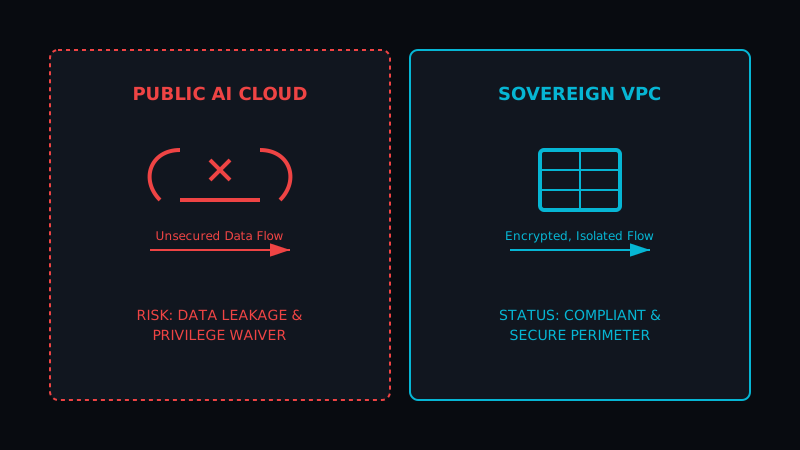
- Ingestion: Proprietary datasets are submitted to third-party public models.
- Retention: Per default Terms of Service (TOS), the provider retains input data for “Service Improvement” or “Safety Research.” Enterprise-tier agreements can contractually opt out of this retention, but the free and prosumer tiers employees reach for by default typically cannot, and the opt-out itself must usually be actively negotiated rather than assumed — and the employee submitting the data rarely knows which tier the organization is actually using, or whether a contractual opt-out was even negotiated.
- Latent Exposure: The data leaves the organization’s jurisdictional control, effectively waiving Attorney-Client Privilege and risking eventual data regurgitation in future model training iterations.
The privilege waiver is the sharper legal exposure of the three, and in GridBase’s experience it is frequently underweighted relative to the data-security framing. Attorney-client privilege and work-product protection generally require that communications remain confidential; voluntarily disclosing privileged material to a third-party service, even one marketed as secure, can be treated by a court as a waiver of that protection for the disclosed material and potentially related communications. Unlike a data breach, which the organization can frame as a security failure outside its control, a privilege waiver through voluntary submission is difficult to characterize as anything other than the organization’s own action.
The Air-Gapped Solution
For high-stakes operations, reliance on external APIs for Tier-1 Data is an unacceptable Operational Liability.
Blocking consumer AI domains at the network perimeter is a necessary control but an insufficient one on its own; the perimeter and detection layer for this specific exposure is detailed in Shadow AI Perimeter Enforcement. A migration plan that only restricts access without providing a sanctioned, comparably capable alternative predictably pushes usage toward personal devices and unmanaged accounts, where visibility is lost entirely rather than merely restricted.
GridBase recommends the deployment of Sovereign Architectures. We design Private VPCs (Virtual Private Clouds) utilizing high-reasoning open-weight models like Mistral-Large or Llama-3-70B, selected specifically because their weights can be hosted entirely within the organization’s own infrastructure rather than behind a vendor-controlled API.
- Egress Lockdown: The inference environment is configured with zero outbound internet gateways, containing telemetry leakage.
- Volatile State: Context windows are processed via ephemeral RAM and purged immediately post-generation.
- Weight Sovereignty: The organization controls the specific model weights in use and their update cadence, rather than inheriting silent vendor-side changes to a shared public endpoint.
The economic objection to this migration is usually inference cost and setup time relative to a public API’s near-zero marginal cost. This framing compares the wrong two numbers. The relevant comparison is the fully loaded cost of a Sovereign Architecture against the cost of a single Tier-1 privilege waiver and its downstream litigation exposure, not against the API’s per-token price, which makes the comparison look favorable only until the first incident forces the real one.
Doctrine
Security is not a policy document; it is architecture. Organizations that do not control their weights do not control their data. For law and finance specifically, where the underlying data is routinely privileged or materially non-public, this is not a general best practice; it is the baseline condition for the organization’s own confidentiality obligations to remain intact.