The Regulatory Horizon
The era of unregulated model deployment within the European single market has concluded. For US-based SaaS providers, surviving the EU AI Act is no longer a distant legislative possibility; it is an immediate operational constraint. If your infrastructure processes EU citizen data—regardless of your physical headquarters—you are now categorized as a regulated entity under extraterritorial jurisdiction.
The Tiering Myth
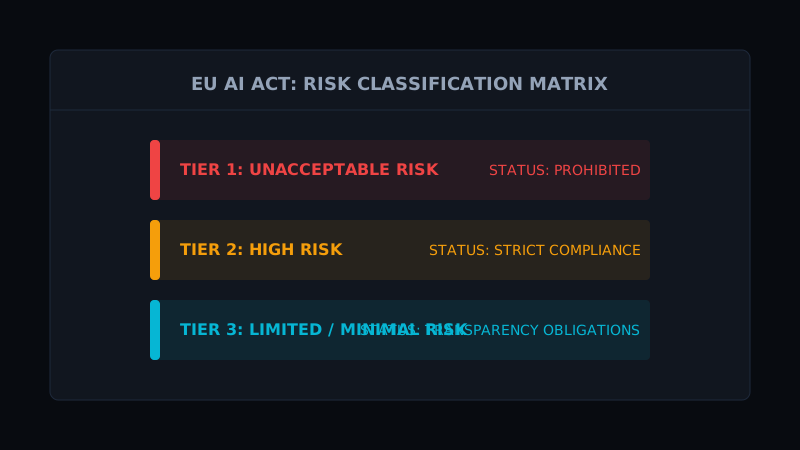
Internal GridBase assessments indicate that a significant portion of SaaS founders miscalculate their risk profile. Most panic, assuming their systems fall under “High-Risk” (Annex III) categories. In practice, most B2B SaaS integrations reside within the “Limited Risk” tier, which focuses primarily on Transparency Obligations rather than the heavier Annex IV documentation burden.
Miscalculating in either direction carries cost. Over-classifying a Limited Risk system as High-Risk diverts engineering effort into a quality management system and technical file the product does not need. Under-classifying a genuine High-Risk system as Limited Risk is the more dangerous error: it leaves the mandatory HITL override and Annex IV documentation unbuilt, and the misclassification itself becomes a separate compliance failure on top of the missing controls, since regulators treat an incorrect self-assessment as evidence the organization’s risk process is not functioning.
Limited Risk Requirements (Transparency)
Organizations in this tier must operationalize two specific technical mandates:
- Active Disclosure: Users must be explicitly informed when interacting with an AI system. This is a baseline requirement for Sovereign Architecture.
- Synthetic Labeling: All AI-generated content (text, image, or code) must be machine-readable as synthetic to mitigate misinformation liability.
Both obligations apply regardless of whether the AI functionality is the product’s primary feature or an embedded convenience. A project-management tool with an AI-generated summary feature carries the same disclosure and labeling obligations as a dedicated AI product for that specific feature, a distinction founders frequently miss when scoping their own compliance surface.
High-Risk (HR) Classification
If your system impacts critical areas such as employment, credit scoring, or healthcare, you are subject to Annex IV:
- Annex IV Technical File: You must maintain a comprehensive log of training data sources, data provenance, and model performance metrics.
- Sovereign Oversight: Systems must feature a “Human-in-the-Loop” (HITL) override—a technical stop-button capable of neutralizing model output in real-time.
- Conformity Assessment: Before market placement, the system must undergo a documented conformity assessment against the applicable requirements, producing the evidence trail regulators and enterprise procurement teams will request.
The 30-Day Alignment Sprint
To maintain market access, US entities must shift from “Strategic Intent” to Operational Alignment. GridBase recommends a three-step sprint to establish audit-readiness:
- Inventory Audit: Mapping every LLM call and classifier within the product stack.
- Perimeter Fortification: Implementing the necessary disclosure UI and synthetic watermarking protocols.
- Documentation Snapshot: Generating a Technical Regulatory Analysis that justifies your risk classification to potential auditors.
Liability Disclaimer: Classification is based on current architectural interpretation of the Regulation (EU) 2024/1689. Final risk categorization must be verified via independent legal counsel.
Why Sequencing Matters
Classification must be resolved before the technical build begins, not alongside it. The disclosure UI, the synthetic watermarking format, and the technical file’s structure are all determined by which tier applies — building any of them before classification is confirmed routinely means rebuilding once the correct tier is known. GridBase recommends treating the 30-Day Sprint’s first week as a hard gate: no downstream engineering work is scoped until classification is signed off.
Conclusion: Velocity through Governance
Compliance is frequently viewed as a friction point. However, in the 2026 procurement cycle, compliance is the prerequisite for velocity. Organizations that fail to provide a “Technical File” will be barred from EU enterprise contracts.
GridBase provides the Gap Analysis Audit required to determine your classification and fortify your technical documentation within a 48-hour cycle.
The Cost of Waiting
The 30-Day Sprint compresses well when classification is already known. It does not compress when classification itself is contested or unclear, since resolving genuine ambiguity in a system’s risk tier — particularly borderline High-Risk cases touching employment or credit decisions — can itself take longer than 30 days if legal and engineering are not aligned from the outset. Providers that begin the sprint only after receiving a customer’s compliance questionnaire are starting from a materially worse position than those who complete classification before it becomes a sales blocker, since enterprise procurement cycles rarely leave 30 days of slack once the question has actually been asked, and a stalled enterprise deal is a harder cost to recover than the engineering hours the sprint itself requires.