The Permanence of Weights
Unlike a database record, a trained weight has no natural expiration and no straightforward mechanism for selective removal. This single architectural fact is the source of nearly every downstream complication this doctrine addresses, from the legal status of deletion requests to the economics of remediation when memorization is discovered after deployment rather than before it.
In the current deployment cycle, a dangerous fallacy exists: the belief that “deleting” a user from a database removes them from the ecosystem. In reality, once data is ingested into the training set of a Large Language Model, it is encoded into the model’s Latent Memory. This data does not exist as a clear-text string but as a distributed pattern of weights—a “ghost” that can be summoned through Adversarial Probing.
This distinction has a direct consequence for any deletion or “right to be forgotten” request the enterprise receives. A database deletion removes a row; a model that was trained on that row retains the statistical influence of its content in its weights regardless of what happens to the original source record. The organization can delete every copy of the source document and still be hosting a system capable of reproducing its contents, because the model’s weights were never the document—they were a compressed, distributed encoding derived from it.
Mechanism: Semantic Memorization
Large models (GPT-4o, Llama 3) exhibit “Memorization” where they can perfectly reconstruct specific training sequences. For enterprises, this represents a terminal failure of data privacy.
Memorization is not a training defect correctable through better engineering; it is a predictable consequence of how these models are optimized. A sequence that appears many times in training data, or that is sufficiently unusual to stand out from surrounding text, is statistically more likely to be memorized verbatim rather than generalized into a pattern. Enterprise data is disproportionately exposed to this risk precisely because it tends to contain the kind of low-frequency, high-specificity content—client names paired with case details, account numbers, internal project codenames—that memorizes more readily than generic prose.
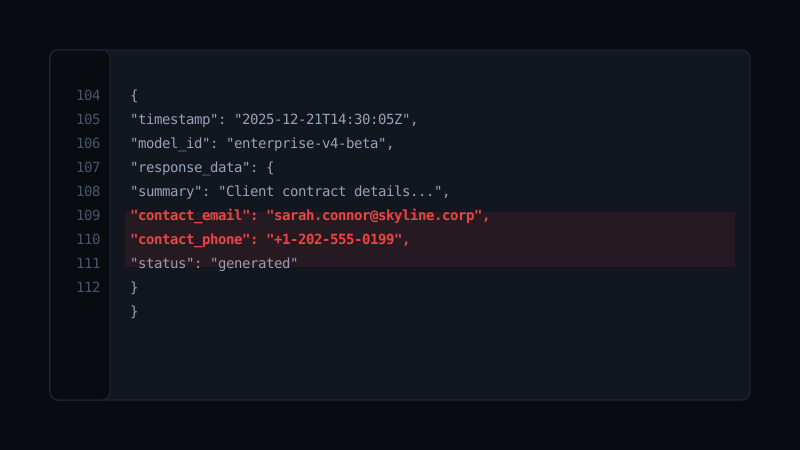
- PII Extraction: Attackers use “prefix-probing”—providing the start of a known sensitive document or a person’s name—to trick the model into completing the sequence with a phone number, address, or social security number.
This technique does not require the attacker to already know the sensitive content; that is precisely what makes it an extraction attack rather than a confirmation. An attacker who already possesses a partial record—a person’s name and employer, say, obtained from a public source—can use prefix-probing to determine whether the model’s training data contained additional, non-public details about that person, and if so, attempt to extract them. The public fragment is the key; the model’s memorization is the lock it opens.
- Latent Drift: As models are fine-tuned on specialized corporate datasets, the risk of “cross-contamination” increases, where proprietary logic from one client Matter inadvertently resurfaces in another client’s inference session.
This is the specific failure mode that makes shared fine-tuned models unsuitable for multi-client professional services firms without additional isolation. A single fine-tuned model trained across all client matters creates one shared latent space where any client’s data can, in principle, influence output served to any other client—the fine-tuning process has no inherent concept of which client a given training example belonged to once training is complete.
The Extraction Threat Vector
A study on training data extraction demonstrates that the larger the model, the higher the capacity for memorization.
This scaling relationship has a counterintuitive implication for enterprise procurement. The largest, most capable foundational models—the ones enterprises are often drawn to for quality reasons—carry proportionally higher memorization risk than smaller models for the same fine-tuning dataset. A procurement decision optimizing purely for benchmark performance, without weighing this trade-off, can inadvertently select the model configuration with the worst memorization exposure for a given sensitive dataset. For legal and financial firms, this means that the very act of “improving” a model through fine-tuning on internal data may create a permanent, exfiltratable record of that data.
- Direct Memorization: Reconstructing clear-text strings from the training set.
- Inference-Time Leakage: Probing the model’s “Internal Monologue” to extract Shadow AI data that was supposedly purged.
- Membership Inference: Without reconstructing any content directly, an attacker determines whether a specific record was present in the training set at all—confirming, for instance, that a named individual’s data was used to train a model, which can itself be a disclosable fact under some privacy regimes even without extracting the content.
- Attribute Inference: Probing the model to infer sensitive attributes correlated with, but not explicitly stated in, the training data—reconstructing a plausible profile of an individual from patterns the model learned about similar records, without ever memorizing that individual’s record directly.
Mitigation: Semantic Sanitization
To Mitigate latent memory risks, GridBase recommends a Defense-in-Depth approach:
- Differential Privacy: Implementing mathematical noise during the training or fine-tuning process to limit reconstruction of any single data point.
Differential privacy carries a direct utility trade-off: the noise that limits reconstruction of individual records also degrades the model’s ability to generalize sharply from the training data, which can measurably reduce output quality for tasks requiring precise recall of specific facts. GridBase treats the privacy budget—the parameter governing how much noise is applied—as a decision that should be made deliberately against the sensitivity of the underlying data, rather than adopting a single default setting across every fine-tuning job regardless of what the training data actually contains.
- PII Scrubbing: Rigorous, multi-pass automated redaction of datasets before they touch the training pipeline. A single-pass filter catches the obvious cases; multi-pass redaction, cross-referencing multiple entity-detection approaches against the same corpus, catches the PII that one approach alone reliably misses—particularly PII embedded in unstructured narrative text rather than clean structured fields.
- The Snapshot Rule (Preview): Documenting the exact state of a model’s weights to ensure that any “memorization drift” can be identified and reverted, consistent with the dated-verification discipline detailed in the Snapshot Rule.
- Extraction Testing: Before deploying any fine-tuned model to production, GridBase recommends running systematic prefix-probing and membership-inference tests against the model itself—treating memorization as a measurable property to verify, not an assumption to trust. A model that has not been tested this way carries unknown memorization risk regardless of how rigorous the upstream PII scrubbing was, since scrubbing failures and residual memorization are only confirmed absent through direct testing of the trained artifact.
Why Remediation Rarely Means Retraining
Discovering memorized sensitive data in a deployed model does not, in most cases, justify retraining from scratch—a costly and slow remedy that is frequently disproportionate to the exposure. The more common response is output-layer filtering: deploying a detection pass on generated completions that screens for and blocks the specific category of memorized content discovered, while a longer-term fix to the training pipeline is planned for the model’s next scheduled retraining cycle. This is a containment measure, not a cure; the underlying memorization remains in the weights until the model is genuinely retrained on cleaned data, which is why discovered memorization should be tracked as an open item against a defined remediation timeline rather than treated as resolved once the output filter is in place.
Scoping Which Deployments Carry This Risk
Not every AI deployment carries meaningful memorization exposure. A deployment using a foundational model purely through its API, with no fine-tuning on enterprise data, does not expose the enterprise’s own records to this risk—the enterprise’s data never entered that model’s training set. The risk concentrates specifically in fine-tuning and continued-training workflows, where enterprise data is deliberately used to further train a model the enterprise will later serve. This distinction matters for prioritization: an organization running ten AI integrations, only two of which involve fine-tuning on proprietary data, should concentrate its memorization-risk mitigation on those two rather than applying uniform scrutiny across all ten.
Conclusion
Data in an LLM is not “stored”; it is “learned.” Once learned, it is nearly impossible to “un-learn” without a complete retraining of the model. Organizations must treat their training pipelines as a one-way threshold for their most sensitive intellectual property. Where retrieval pipelines compound this exposure, see Preventing PII Leakage in RAG Pipelines; where the exposure originates from unsanctioned model access, see Shadow AI Perimeter Enforcement.
Status: Intelligence Locked. Entity: GridBase