The End of “Shadow AI”
As we conclude 2025, the enterprise era of loosely governed, “experimental” AI usage is over. The coming year, 2026, will be defined by the Industrialization of AI Red-Teaming — a shift from occasional, manual engagements to continuous, tooled assessment. Regulatory bodies and insurance underwriters no longer accept “Best-Effort” safety; they require Sovereign Documentation and technical proof of adversarial resilience.
The insurance dimension of this shift is easy to underweight relative to the regulatory one. Cyber-liability underwriters are beginning to request the same adversarial testing evidence regulators do, and a policy renewal can turn on whether that evidence exists in a form the underwriter recognizes, independent of whether a regulator has asked yet.
The 2026 Strategic Pillars
GridBase identifies three dominant, interlocking signals that will dictate corporate AI strategy across the first half of 2026:
Compliance-Driven Audits
The EU AI Act will force a massive shift in how US-based SaaS firms validate their models. The “Annex IV Technical File” will become the standard prerequisite for any meaningful B2B contract within the European Union.
Automated Adversarial Probing
Manual red-teaming, run quarterly or annually, is too slow for the pace at which 2026 deployments now change. We anticipate the widespread deployment of automated probing toolkits (e.g., garak, PyRIT) to continuously stress-test models against new injection vectors, following the methodology detailed in Probabilistic Breach.
The Shift to Sovereign Infrastructure
The Copy-Paste failures of 2025 have proven that public APIs are a liability for Tier-1 data. 2026 will see the “Great Migration” to private VPCs and air-gapped inference nodes, architecture detailed in Air-Gapped Inference Pipelines.
Operational Alignment
For the “C-Suite” specifically, the priority is moving from Innovation to Fortification. The question is no longer “What can AI do?” but, more urgently, “How do we survive its deployment?”
Organizations that fail to Align their technical architecture with emerging global standards—specifically the NIST AI Risk Management Framework—will face significant “Jurisdictional Friction” and potential market exclusion.
The Doctrine of Persistence
In 2026, security is not a destination; it is a Temporal State, formalized in the Snapshot Rule. GridBase is moving toward a continuous intelligence model, where audits are provided as time-stamped “Snapshots” of a model’s current defensive perimeter rather than a single annual certification.
The three pillars above are not independent trends; they compound. Compliance-driven audits create the demand for automated probing at the volume manual red-teaming cannot sustain, and the shift to sovereign infrastructure is, in large part, a response to the same audits demonstrating that public-API dependencies cannot produce the evidentiary trail regulators are starting to require.
Conclusion: Preparation for Jan 04
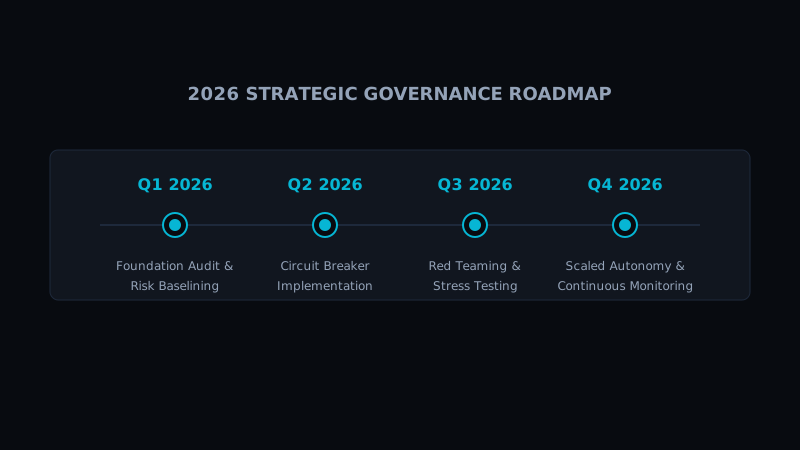
On January 4, 2026, GridBase will officially initiate the Diagnostic Assessment protocol for our core clients. The transition from 2025’s warnings to 2026’s concrete architectural mandates is now essentially complete.
For organizations that have not yet begun this transition, the practical starting point is not the most sophisticated pillar but the most foundational one: an honest inventory of every AI integration currently in production, sanctioned and unsanctioned alike. Compliance audits, adversarial probing, and sovereign infrastructure migration all depend on first knowing the full scope of what is actually deployed — a surprising number of 2026 compliance failures will trace back not to a control that failed, but to an integration nobody inventoried in the first place. The fortress is being built, and its first wall is knowing the perimeter.
Reading the Three Pillars Together
None of the three pillars above is optional in isolation. An organization that completes compliance documentation but never runs adversarial probing has produced paperwork describing a system it has not actually stress-tested. An organization that probes aggressively but remains on public, shared infrastructure has generated evidence of vulnerabilities it has no sovereign environment to remediate quickly. The three pillars are a single posture, not a menu, and 2026 procurement and regulatory pressure will increasingly test all three simultaneously rather than rewarding strength in one while ignoring gaps in the others. Organizations planning their 2026 security budget around a single pillar — typically compliance documentation, being the most visibly demanded by customers — should expect that budget to prove insufficient the first time a regulator or an underwriter asks for the adversarial testing evidence sitting behind the paperwork, evidence that a documentation-only budget, however thorough its paperwork, was never structured to produce in the first place.
Status: Intelligence Locked. Entity: GridBase Protocol: Encrypted Async